


By Matthew Gutierrez and Shawn O’Malley
To the "value investors” reading this newsletter, we want to know — are you going to Omaha this year to attend Berkshire Hathaway’s shareholder meeting in May?
If so, fill out this quick survey. We’d love to connect with you.
— Matthew & Shawn
Here’s today’s rundown:

Today, we'll discuss the biggest stories in markets:
Investors absorb the possibility of no rate cuts this year
Can the golf boom last?
This, and more, in just 5 minutes to read.
POP QUIZ
Chart of the Day

Together With Anytime Mailbox
Ready To Start Your Business? The First Step Is A Mailbox*

Secure a physical address through Anytime Mailbox’s vast 2100 International address network. Find an address around the corner, in NY, LA, or Paris.
There’s plenty to choose from! For as low as $9.99 per month, you’ll have an address to use when filling in forms, receiving postal mail, business cards, returns, and more. It’s easy, and there’s no long term commitment.
The best part? You keep your home address private.
*Sponsored content
In The News
😅 Markets Digest Possibility Of No 2024 Rate Cuts
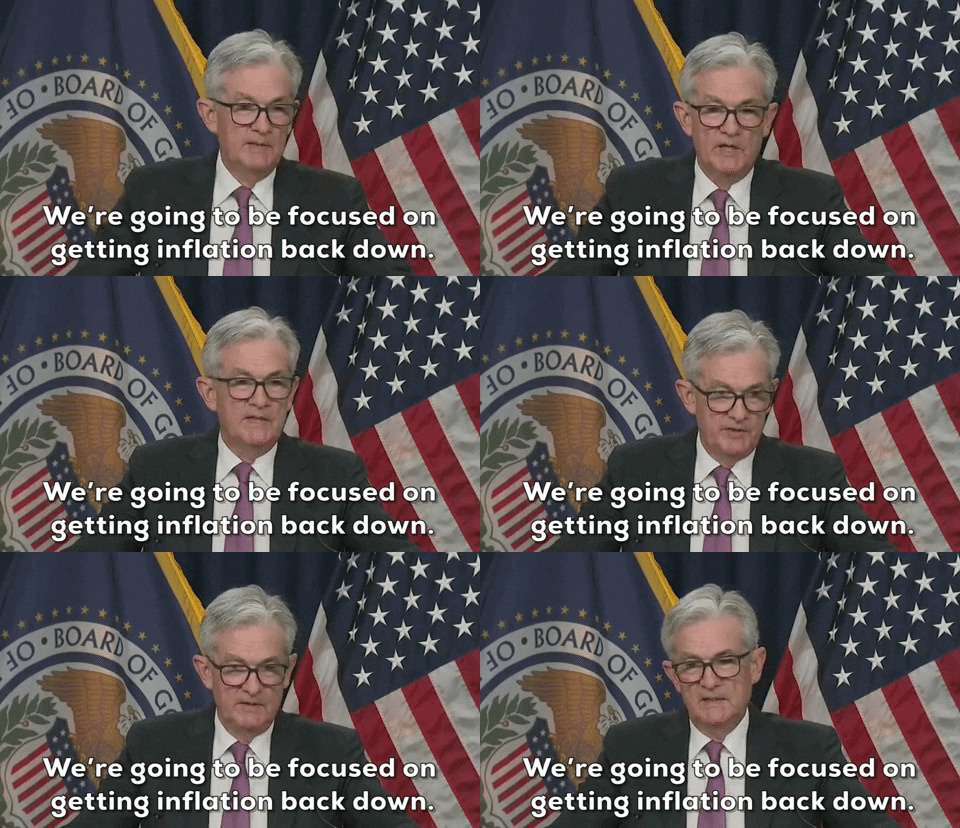
The unthinkable is now thinkable. That’s the prospect of no rate cuts this year. Predicting no cuts just a few months ago would’ve left you all alone on Wall Street, excluded from the cool kids’ table, which was betting on at least three rate reductions this year.
Alas, upticking inflation has thoroughly disrupted that narrative. While cuts were originally expected as soon as June, the first full rate cut now isn’t priced to happen until November, with doubts about any cuts this year becoming increasingly mainstream on Wall Street.
The Nasdaq and S&P 500 fell almost 1% in response, underscoring investors’ unease with the prospect of sticky inflation above 2% (actually, above 3%.)
Across the curve: But it’s not just short-term interest rates adjusting to a hotter inflation outlook; Wednesday’s hot CPI report rippled across the yield curve.
Thanks to three straight higher-than-expected monthly inflation reports, Bloomberg notes, “yields across the (Treasury bond) maturity spectrum were higher by around 20 basis points in late afternoon trading,” with two-year Treasuries moving up the most to nearly 5%.
One bond fund manager added, “I see a 75% chance that the Fed will start cutting interest rates in September and a 25% likelihood of no cuts at all this year.”

Why it matters:
As we’ve mentioned previously, two things fundamentally underpin stock prices: corporate earnings—the driver of companies’ equity value, which is what investors pay to own—and discount rates, which represent investors’ opportunity costs and determine how much they’re willing to pay per share for a dollar of corporate earnings (aka higher or lower P/E multiples).
Discount rates are directly linked to the Fed’s policy interest rate. So, while economic resilience is good for corporate earnings (and therefore stock prices), that same economic strength can push demand out of whack with supply and stoke inflation (keeping interest rates higher—bad for stock valuations).
That is, arguably, what we’re seeing today. A blowout March jobs report reinvigorated beliefs that the economy is remarkably strong.
However, with that strength—more people being employed and thus having more income to spend—“aggregate demand” will likely remain firm. That would make it harder to bring inflation to 2%.
Opposing forces: There’s an ongoing tug-of-war in markets, with higher-for-longer interest rate expectations acting as a headwind and strong economic data acting as a tailwind.
The rubber will meet the road in the next few weeks as companies’ Q1 earnings comes in.
Stock indexes falling even modestly short of analysts’ profit projections, combined with the interest rate outlook being revised higher, would pose major challenges for this bull market.
More Headlines
💊 Drug shortages hit an all-time high
🇻🇳 Vietnamese tycoon sentenced to death over $12 billion fraud
🦄 Uniswap is the latest crypto platform targeted by SEC
⛳ No inflation at the Masters: Why concession prices remain so cheap
🤑 Who pays the most and least in taxes
🗣️ China says economy ‘stable,’ rejects Fitch ratings downgrade
🏌️ Golf Is Booming. But Can the Good Times Last?

Made Using DALL-E
Folks, Happy Masters week.
The hottest trend in sports is pickleball, but the old-fashioned game of golf — “a good walk spoiled,” per Mark Twain — is holding its own.
According to the National Golf Foundation, the number of rounds played in the U.S. in 2023 (531 million rounds) increased by a record 10%. This surpasses the previous high during the Tiger Woods boom years of 1999-2000, also around the peak of that stock market cycle. Stock market highs may seem like a strange connection to interest in golf, but as people “feel” wealthier, they’re more likely to indulge in expensive hobbies like golf.
Several other factors are at play:
Diverse participation: Golf is still a sport reserved mostly for white people and wealthier Americans. However, the U.S. golf population is more diverse than ever, with gains by women, people of color, and junior golfers.
Increased demand: Despite a 12% reduction in golf courses over the past 15 years, demand for tee times has surged, leading to higher green fees in some markets.
Public-sector course operators, eager to maximize revenue, have faced little resistance to congestion pricing during periods of peak demand.
Off-course golf experiences: The popularity of off-course facilities like driving ranges, golf simulators, and entertainment-oriented venues like Topgolf has increased by 41% since 2019. Over 32 million people engaged in such activities last year. Simulators have also gained a lot of popularity.
Pandemic boost: Golf proved to be one of the safest outdoor recreation activities during the pandemic, and new programming and value-added memberships have made clubs more welcoming.
Private clubs have waiting lists for memberships—something many haven’t seen in two decades.
Golf course closures in 2023 fell to their lowest levels since before the Great Recession. There were also more new course openings last year than at any time since 2010.
The stock market's return to all-time highs likely means many golfers feel richer and are thus more inclined to spend money on sports, entertainment, and leisure.
The industry still needs to appeal to a broader, more diverse audience to sustain this growth. It’s also trying to address environmental concerns: Clubs are investing in infrastructure upgrades, efficient irrigation systems, and more sustainable practices to ensure long-term viability.
Why it matters:
Golf’s resurgence is a good example of a relatively luxury market staying relevant in an age of inflation, higher borrowing costs, higher labor costs, less labor availability, and restricted access to water, especially in the U.S. West and Southwest. There’s also the rapidly escalating cost of maintenance.
Great game, good biz: Golf is also one of many industries (think tourism, boating, etc.) that has been increasingly impacted by changing weather patterns and climate change (heat waves, floods, hurricanes). That’s forcing course owners and executives to get more creative about memberships and tech advancements.
The Wall Street Journal reports: “Golf will always be a great game; but it could also become a good business.”
Together With Money.com
Diversify Your Portfolio & Safeguard Your Retirement*

Safeguarding your retirement with a Gold IRA can help you shield your wealth from market shifts, economic uncertainty, and inflation.
And with gold’s value projected to increase in 2024, now is a good time to invest. Planning for retirement involves more than saving, so fortify your portfolio with gold today and plan for a better tomorrow.
See our list of Best Gold IRA Companies to start planning a better retirement.
*Sponsored content
Quick Poll
Have you become a more active golfer since the pandemic?
Yesterday, we asked: Do you think St. Louis, and similar midwest cities struggling with hallowed-out downtowns, can turn things around?

— People had a lot to say about this topic. Many readers believe midwest cities can turn around, but it won’t happen soon. “Poor politics leads to crime, malinvestment, and thus the death spiral. It’s very simple, people and capital will go where they are treated best.”
— Added another, “Here in Houston, a downtown turnaround began when they built and moved the soccer stadium, baseball, and basketball stadiums downtown. This, in turn, added hotels, bars, restaurants, and the ability to attract Final Fours, Super Bowls, etc.”
— Other readers pointed to the flight to the suburbs, plus the flailing city infrastructure, remote work, and the high cost of living in cities, have all contributed to midwest cities’ demise as factors that “have irrevocably undermined the allure of urban living.”
— One believer that these cities will recover said, “We know that neighborhood life cycles follow phases of growth, stability, decline, and renewal. Similar concepts can be used for commercial centers and we see this often.”
TRIVIA ANSWER
See you next time!
That's it for today on We Study Markets!
If you’re a sophisticated investor looking for more professional insights, check out We Study Markets Pro.
Enjoy reading this newsletter? Forward it to a friend.
Was this newsletter forwarded to you? Sign up here.
Use the promo code STOCKS15 at checkout for 15% off our popular course “How To Get Started With Stocks.”
Advertise with us.
Follow us on Twitter.
Keep an eye on your inbox for our newsletters on weekdays around 6pm EST and on weekends. If you have any feedback for us, simply respond to this email.
You can also leave your comments/suggestions/feedback anonymously here.
What did you think of today's newsletter?
All the best,


P.S. The Investor's Podcast Network is excited to launch a subreddit devoted to our fans in discussing financial markets, stock picks, questions for our hosts, and much more!
Join our subreddit r/TheInvestorsPodcast today!
© The Investor's Podcast Network content is for educational purposes only. The calculators, videos, recommendations, and general investment ideas are not to be actioned with real money. Contact a professional and certified financial advisor before making any financial decisions. No one at The Investor's Podcast Network are professional money managers or financial advisors. The Investor’s Podcast Network and parent companies that own The Investor’s Podcast Network are not responsible for financial decisions made from using the materials provided in this email or on the website.
