


By Matthew Gutierrez and Shawn O’Malley
Soft inflation data is a pleasant sight to behold 🙌
Tuesday’s CPI report showed high prices (particularly gasoline and housing) are easing.
As of October, the Consumer Price Index has risen just 3.2% since last year. Though we’re not at the Fed’s goal of 2 percent, the report provides more evidence for Fed officials that their strategy has things moving in the right direction.
💭 “We see further disinflation in the pipeline in 2024 from rebalancing in the auto, housing rental, and labor markets,” Goldman economists said this week.
As you’ll see below, the stock market loves to see it and just recorded its best day since April.
— Matthew & Shawn
Here’s today’s rundown:

POP QUIZ
Today, we'll discuss the three biggest stories in markets:
Why Moody’s turned negative on the U.S.
How Wall Street makes millions off car loans Americans can’t repay
Inside cooling tensions between the U.S. and China
All this, and more, in just 5 minutes to read.
CHART(S) OF THE DAY


IN THE NEWS
👎 Moody’s is Negative on America’s Credit Rating

Another month, another credit rating agency is downgrading the U.S. government.
Well, Moody’s hasn’t fully downgraded the U.S. yet, but they shifted their outlook to “Negative” for Treasury bonds, which finance the country’s deficit spending.
Last holdout: Moody’s is the last of the “Big Three” credit ratings agencies to give the U.S. government a perfect AAA credit assessment after Fitch downgraded U.S. government debt in August (after the latest debt-ceiling battle) and S&P downgraded the U.S. in 2011 (after that year’s debt-ceiling crisis.)
A “negative outlook” enables Moody’s to move forward with a downgrade should deficit spending continue ballooning while Congress routinely struggles to pass basic legislation allowing the federal government to fulfill its obligations.
Moody’s commented, “Continued political polarization within (the) U.S. Congress raises the risk that successive governments will not be able to reach consensus on a fiscal plan to slow the decline in debt affordability.”
Still, at least one important government official disagrees with the negative outlook: Treasury Secretary Janet Yellen assured investors that Treasury bonds are safe assets, saying, “The American economy is fundamentally strong and Treasury securities remain the world’s preeminent safe and liquid asset.”
She added that Moody’s shifting view of U.S. debt is “a decision that I disagree with.”
Why it matters:
Another government shutdown looms before Friday’s deadline to pass a spending bill that funds the government — yes, the last resolution was just a temporary one.
This comes in a year already plagued by turmoil following a last-minute deal to raise the debt ceiling (the government’s ability to borrow more money) while instability and blowout spending in Congress chip away at the U.S.’s perceived credit quality.
Thus, Fitch’s decision to proceed with a downgrade this summer looks increasingly justified after Congress narrowly averted a default, saw the Speaker of the House ousted and was paralyzed by a weeks-long process of finding a new one, and again contends with a crisis at the buzzer to keep the federal government functioning.
While Yellen is right to argue the U.S. isn’t on the precipice of being unable to pay its bills even with massive deficit spending, dysfunction in Congress raises the likelihood of unforced errors that may justify a lower credit rating.
She conceded, “A shutdown is something that poses an unnecessary economic headwind.”
TOGETHER WITH

What’s better than finance news and a chance to win free stuff?
Join Market Hedwig’s Lucky Draw to have a chance at winning an Apple iPad by subscribing to their newsletter!
🦉 Market Hedwig is a top-rated platform where investors can access 5-minute weekly financial articles written by ex-investment bankers, who summarize key market news across asset classes.
🎁 Subscribe to their free newsletter to stay ahead in investing.
🚗 How Wall Street Makes Millions Off Car Loans Americans Can’t Repay

Lenders are profiting millions of bucks while borrowers, mostly low- to middle-income, struggle to pay off car loans with interest rates as high as 29.99%. No, that’s not a typo.
The industry says it’s helping customers with bad credit who need transportation to work, while Americans saddled with debt say it’s unfair.
In essence, Wall Street packages the loans, then resells them as “asset-backed bonds,” in a process called “securitization.”
If this sounds like the plot of the Big Short, but with cars, you wouldn’t be far off.
OK, in English, please: Capital Group and Bank of New York Mellon Corp. use car loans they make to people with bad credit to back bonds, from which they can earn handsome yields. Last year, the car loans backed more than $37 billion of bonds, twice the value as a decade before, according to Bloomberg.
If the borrowers can’t repay (often the case), investors don’t care. Numerous protections, which are a bit complicated, guarantee they’ll get their principal back – while earning interest.
So as customers might be stuck in debt or lose their cars, banks like Santander earn hundreds of millions of dollars.
Defaulting: Santander often counts on the debt going bad, predicting that customers would fail to pay about 42% of the money they borrowed. Thousands of borrowers have defaulted (when borrowers stop making payments), exposing borrowers to legal claims that often limit future access to credit.
Santander told Bloomberg it’s helping Americans access cars, which many Americans need.
But big lenders know they’re setting up lower-income Americans to fail, yet they market these products because they help them rake in the dough.
Said one CEO within the industry: “It doesn’t really work for the consumer, but it works for everyone else.”

From Bloomberg
Why it matters:
Regulators and Congressional members say this practice reminds them of what subprime mortgage lenders did before the 2008 global financial crisis, when brokers sold homes to customers who couldn’t repay, driving a foreclosure crisis.
Congress passed the 2010 Dodd-Frank Act, forcing mortgage lenders to better analyze borrowers' finances to ensure affordable loans. But car dealers, where most loans are created, fought for an exemption, arguing that regulation would hurt their business.
Santander has paid the price for its practices, paying a $550 million settlement in 2020 for abusive lending allegations.
Even still, over one-third of subprime auto loans default, which is nearing the highest default rate for subprime mortgages 17 years ago, at the brink of the foreclosure mess.
U.S. Senator Elizabeth Warren argued that Congress's exemptions for car dealers was a mistake. “The proof is in the pudding.”
MORE HEADLINES
🎶 Beatles’ ‘Now and Then’ becomes their record 35th song in Billboard's top 10
🧸 Toys R Us opening in America’s biggest mall in a comeback attempt
⭐ Webb telescope captures the second-most distant galaxy ever
🔨 Home Depot’s sales fall, but earnings beat estimates
👍 Most Americans think the economy will be in fairly good shape next year
🎓 International students flock back to the U.S., fueled by a surge from India
🇺🇸 🤝 🇨🇳 Tensions Between the U.S. & China Appear to Cool
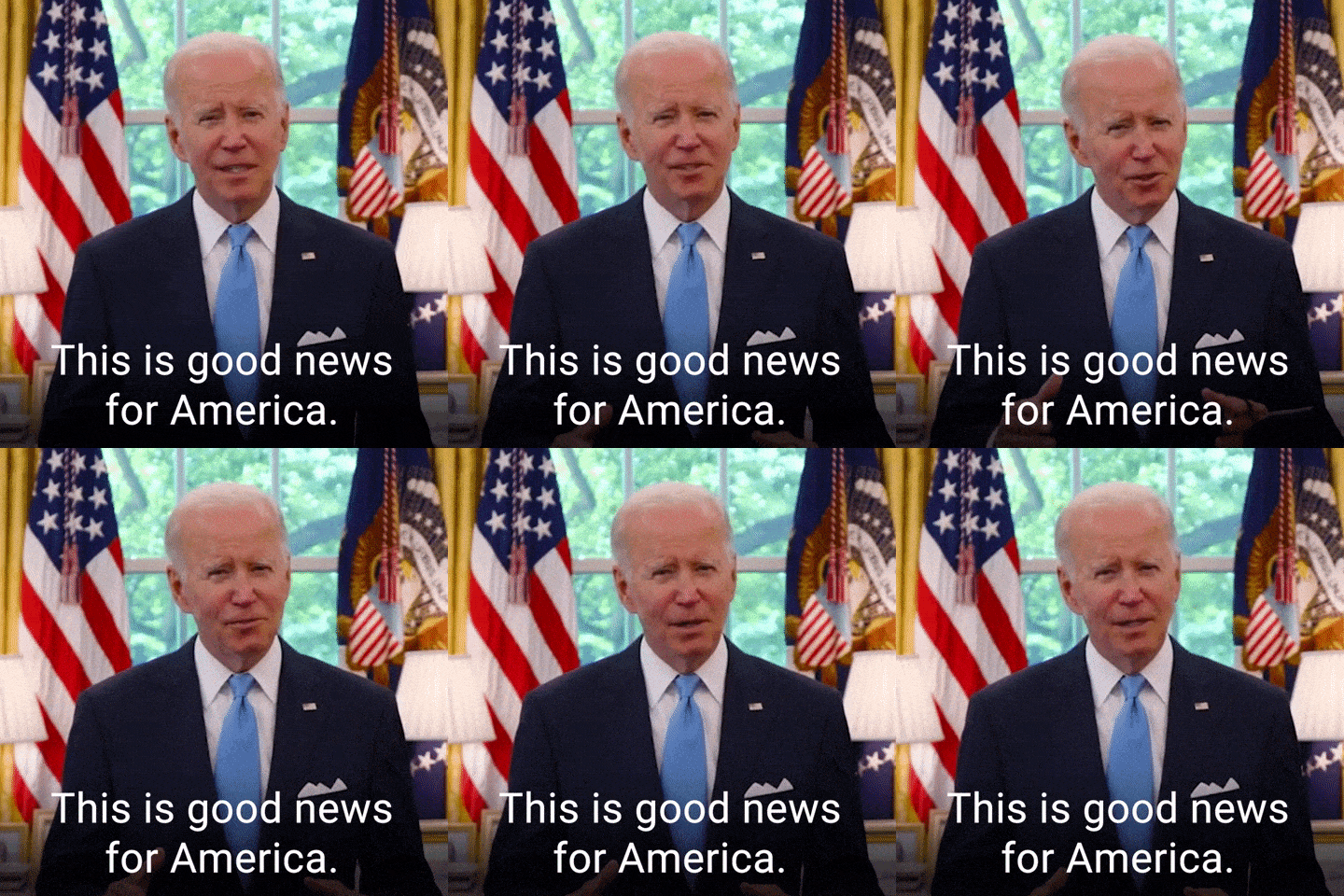
If you’re looking for good news, here’s some: The legendary investor and macro strategist Ray Dalio — founder of Bridgewater Associates, says, “The risks of U.S.-China military war have declined.”
Dalio’s relationships with Chinese leadership date to the 1980s, when he was one of the first prominent foreign investors to visit the developing country. That gives him more authority on the topic than your average billionaire former hedge fund manager.
Running the numbers: He places the odds of a hot conflict between the U.S. and China at 35% over the next ten years, which is still concerning but reflects optimism that there are ample ways to maintain peace.
Dalio highlights, in particular, China’s President Xi Jinping’s upcoming visit to San Francisco, where he will meet with President Biden and various business leaders.
Of course, this is a “rough estimate” — the range of potential outcomes constantly shifts.
Why it matters:
Although Dalio doesn’t expect a full-scale conflict between the two countries, he does expect their struggle to continue in subtler forms.
When did the risk of war peak? Dalio states that the '“two Great Powers” were closest to the brink in “March…(but) realizations by both sides that they were at the brink and looking over the brink into the abyss scared leaders,” prompting a pullback that has cooled tensions.
He believes we’re “shifting into a different type of war.”
A war where “how well one manages and develops (its) own financial, economic, technological, and social strength relative to the opposition is more important than how well one builds up and uses one’s military strengths.”
Ultimately, “the winner of the technology war will be the winner of the economic and geopolitical wars.”
Read more (Dalio’s full write-up)
QUICK POLL
Yesterday, we asked: Which company will be the S&P 500’s most valuable in 10 years?

—Results were all over the map and fairly even. Wrote one Apple voter: “Best moat.” Said a Microsoft fan: “It’s the only one that is exceptionally well run.”
— Another reader argued for Amazon, saying, “Whoever figures out/commercializes satellite internet will swallow Verizon and Comcast whole. Amazon could be the one who commercializes it best due to how much they have to offer. Will probably also nab major sports to their streaming service...offer cheap and affordable phones with their internet. Etc.”
— A Tesla voter stated: “Robots, cars, and energy.”
A Word From The Editor

Talk about distinguishing yourself from the pack as an investor.
For years, we’ve used Seeking Alpha’s Stock Screener to select stocks with strong long-term growth potential. In a noisy investing world, Seeking Alpha provides a clear signal.
📈 It’s one of our favorite platforms for finding quality stock picks and reading commentary from other investors.
Find hidden gems. Invest with confidence. Let Seeking Alpha be your guide.
Invest like a bull with this special offer: a $50 coupon AND a seven-day free trial to see for yourself.
TRIVIA ANSWER
See you next time!
That's it for today on We Study Markets!
Enjoy reading this newsletter? Forward it to a friend.
Was this newsletter forwarded to you? Sign up here.
Advertise with us.
Follow us on Twitter.
Keep an eye on your inbox for our newsletters on weekdays around 6pm EST and on weekends. If you have any feedback for us, simply respond to this email.
You can also leave your comments/suggestions/feedback anonymously here.
What did you think of today's newsletter?
All the best,


P.S. The Investor's Podcast Network is excited to launch a subreddit devoted to our fans in discussing financial markets, stock picks, questions for our hosts, and much more!
Join our subreddit r/TheInvestorsPodcast today!
© The Investor's Podcast Network content is for educational purposes only. The calculators, videos, recommendations, and general investment ideas are not to be actioned with real money. Contact a professional and certified financial advisor before making any financial decisions. No one at The Investor's Podcast Network are professional money managers or financial advisors. The Investor’s Podcast Network and parent companies that own The Investor’s Podcast Network are not responsible for financial decisions made from using the materials provided in this email or on the website.
