


By Matthew Gutierrez and Shawn O’Malley
Consumers are expected to continue swiping their credit cards this month ahead amid the holiday season 🛍️
That’s after record Black Friday sales, followed by record Cyber Monday sales. Could record December holiday sales be next?
With inflation easing, stocks moving higher, and discounts abound, Americans keep on shopping. Developments like one-click ordering and customized algorithms make it easier than ever to spend away.
— Matthew & Shawn
Here’s today’s rundown:

POP QUIZ
Today, we'll discuss the three biggest stories in markets:
Inside the bond market’s historic November
Citadel and big hedge funds spark alarms for regulators
Why it’s important to take Wall Street predictions lightly
All this, and more, in just 5 minutes to read.
CHART OF THE DAY

IN THE NEWS
📈 Biggest Bond Rally Since 1980s Sparks Everything Rally

At long last, the bond market is in the driver’s seat.
Many investors with virtually any kind of bond exposure will tell you how difficult — miserable, even — this year has been for the U.S. bond market.
Back in business, baby: Investors bid up the price of Treasuries, making November their best month since the 1980s and sparking a powerful “everything rally” for everything from bitcoin to tech stocks.
Bond investors are pleased to witness such a rally, as many anticipated a third consecutive year of losses — an unprecedented slide in the Treasuries market.
The Bloomberg U.S. Aggregate Index returned about 5% in November.
The yield on the 10-year Treasury bond — the benchmark for everything from home loans to corporate debt — fell about 0.65 percentage points to 4.29%.
Early Santa Claus rally? Bitcoin is surging. Stocks just posted one of their best Novembers on record. And consumer spending, inflation, and the labor market have all been cooling off.
Because it’s Dec. 1, some investors are already betting on a rally into the year-end that could coincide with the famed “Santa Claus rally.”
Goldilocks slowdown: Who knows what the future holds. (As you’ll see below, Wall Street pros certainly don’t have much of a clue).
But dovish comments from Fed officials, cooling jobs data, and other signs show that the economy is slowing, which has helped drive the recent rally.
“We’ve been getting economic data recently that reinforces the idea of the Goldilocks slowdown,” said one investment strategist. “Inflation is coming down, and at the same time, it hasn’t been unduly impinging growth.”

Why it matters:
U.S. junk bonds have risen more than 4%, the most since July 2022, as investors throw $11.9 billion into ETFs tracking the asset class — the most ever, per Bloomberg. Those bonds are also known as high-yield bonds and rated as “speculative” or “below investment” grade, because the corporate borrowers behind them tend to have shakier or less proven finances.
“There’s a little bit of the fear of missing out,” said a rates strategist. “Suddenly 5% yields on the 10-year Treasury have become a distant memory.”
Not so fast: The rally comes just before Fed Chair Jerome Powell said the Fed might not be done raising rates. Surprise, surprise! Powell said he still needs to see inflation near the 2% target.
"It would be premature to conclude with confidence that we have achieved a sufficiently restrictive stance, or to speculate on when policy might ease," Powell said Friday.
But another strategist said markets worldwide are pricing in one outcome for 2024 despite Powell’s comments: rate cuts.
“Oodles of them,” said the strategist.
TOGETHER WITH THE ASSIST

Welcome to The Assist's 2023 Corporate Holiday Gift Guide! 🎁
Discover a handpicked collection of this season's hottest finds, ranging from cutting-edge tech to luxurious indulgences guaranteed to delight your team and clients.
🎉 With options for every budget, we've got your holiday shopping covered – consider it checked off your to-do list!
📊 Citadel & Peers Pile Into Same Trades, Alarm Regulators

Ken Griffin’s hedge fund, Citadel, is dominant, overseeing over $1 trillion. But there appear to be some copycats — or at least a lot of groupthink — raising eyebrows in Washington.
Regulators are increasingly watching hedge funds for their so-called “crowded trades,” in which multiple funds pile into the same trades, hoping to make out like bandits, earning billions of dollars in returns while satisfying their wealthy clients.
It’s a problematic strategy because if/when they exit the trade simultaneously, it could lead to widespread losses and wipe out retail investors in the blink of an eye.
Hedge funds Citadel, Millennium Management, and Balyasny Asset Management lead the strategy by divvying up trades amongst their many teams. Their success over the past few years has drawn attention and scrutiny.
Even Griffin knows the risks: “Could you see the multimanager hedge funds take a joint 10, 15, 20% hit to their equity? It’s possible,” Griffin said last month, calling such a drop “painful, but not systemic.”
Snowball effect: Officials at the Securities and Exchange Commission and U.S. Treasury Department have notified the firms that their trading strategies could destabilize Treasury markets. One large bank is already nearing the limit of how much money they’ll lend them.
“There’s some overcrowding and concern about the amount of leverage at individual firms and collectively,” said one investment consultant. And because the big hedge funds typically exit positions quickly, “we are worried about the potential snowball effect.”
Citadel employees and principals stand to benefit greatly from the crowded trades when things go well: They are the firm’s largest investor group, accounting for 27% of the funds.

Source: Bloomberg
Why it matters:
Much to the credit of Griffin and Citadel, the firm gained 38% last year vs. the S&P 500’s -18% return, mostly thanks to its big wins in the energy market.
So damn big: Griffin, who started trading in 1987 in his college dorm, founded Citadel in 1990. Today, it has $62 billion under management — so enormous that it “could at times represent a high multiple of average daily trading volumes,” which could limit its ability to sell quickly without sending prices tumbling.
According to Bloomberg, Citadel is up about 13.7% this year through October, while many other large hedge funds have posted returns only in the single digits. The S&P 500 has risen about 20% year-to-date. Regulators worry Citadel’s continued success could drive more hedge funds to crowd into its trades.
“We are in the risk-taking business,” Citadel told Bloomberg. “Our investors expect us to deploy their capital against the most attractive opportunities we see in the market.”
MORE HEADLINES
🥙 Panera files for IPO in 2024, with JP Morgan as lead underwriter
💻 Inside Apple’s chip lab, home to its most ‘profound change’ in years
⚽ Christiano Ronaldo faces $1 billion lawsuit for endorsing worthless NFTs
🏠 How HOA fees and fines add to the housing affordability crisis
🗣️ Return to office plans are “dead,” says Stanford economist
💵 Why the U.S. dollar could stay strong through 2024
🧂 Take Wall Street Predictions With a Grain of Salt
Gif by fleischerstudios on Giphy
In case you need another reminder, most Wall Street forecasts about what will happen in markets aren’t worth the paper they’re written on (or digital space they occupy?)
As the Wall Street industrial complex gears up to publish predictions about 2024, it’s a good time to take stock of how predictions for 2023 fared.
Year of the bear: Looking back, as Bloomberg’s Katie Greifeld outlines, the average forecast for the S&P 500 anticipated it to decline, marking the first time since 1999 that most Wall Street strategists were bearish about the year to come.
Of course, the S&P 500 is sitting on 19% year-to-date gains in 2023. Short of a really bad December, it’s safe to say these assessments were resoundingly wrong.
Nothing like the prospect of a year of Fed rate hikes to bring out bearish fantasies across the financial world.
Why it matters:
While the rate hikes happened, the worrying follow-up effects haven’t manifested. Namely, no recession, no big dents in corporate profits, no drop in consumer spending, no job market or housing market implosions, and so on.
We’ve spent a lot of time covering the different explanations for this and the nuances of the conversation, so the point here is more that, often, the “smartest people in the room,” or at least that’s how many on Wall Street perceive themselves, are no better you or us at predicting the future.
No amount of fancy modeling and extrapolations of past data can meaningfully foresee what’s next in markets.
Some studies show that you might be better off just flipping a coin.
One question: Greifeld makes another point, saying, “Even if you knew, what would you do? Having the proper information and starting point in hand is useful, but markets are under no obligation to behave. It’s a fun thought exercise.”
In other words, even if you predicted correctly that inflation would come down, the Fed would do as many rate hikes as they did, and corporate profits/jobs/the housing market would all hold up as they did — could you have predicted how financial markets would behave?
Maybe, but as mentioned, markets are under no obligation to respond to events in the way you expect or think they should.
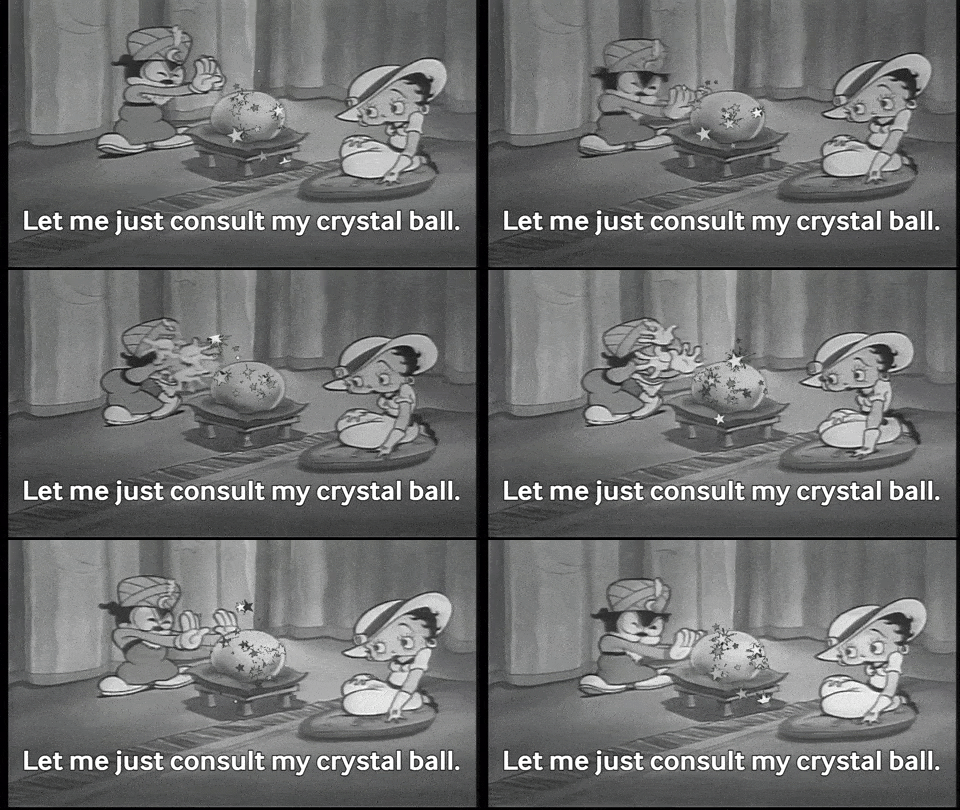
If we had a crystal ball to tell you every major event in 2024, could you still play the markets correctly?
That said, here are some Wall Street predictions for 2024 — take them with a grain of salt: (Read more)
QUICK POLL
How closely do you pay attention to market forecasts?
Yesterday, we asked: How often do you dine out to eat?

— One reader, whom we can sympathize with, said: “With the high cost of living these days, I try to limit myself to special occasions only for dining out.”
— This comment stood, too: “If DoorDash counts as eating out, then the answer is more often than I care to admit.”
— “Very rarely to fast food chains. Local stuff only,” commented another.
TRIVIA ANSWER
See you next time!
That's it for today on We Study Markets!
Enjoy reading this newsletter? Forward it to a friend.
Was this newsletter forwarded to you? Sign up here.
Use the promo code STOCKS15 at checkout for 15% off our popular course “How To Get Started With Stocks.”
Advertise with us.
Follow us on Twitter.
Keep an eye on your inbox for our newsletters on weekdays around 6pm EST and on weekends. If you have any feedback for us, simply respond to this email.
You can also leave your comments/suggestions/feedback anonymously here.
What did you think of today's newsletter?
All the best,


P.S. The Investor's Podcast Network is excited to launch a subreddit devoted to our fans in discussing financial markets, stock picks, questions for our hosts, and much more!
Join our subreddit r/TheInvestorsPodcast today!
© The Investor's Podcast Network content is for educational purposes only. The calculators, videos, recommendations, and general investment ideas are not to be actioned with real money. Contact a professional and certified financial advisor before making any financial decisions. No one at The Investor's Podcast Network are professional money managers or financial advisors. The Investor’s Podcast Network and parent companies that own The Investor’s Podcast Network are not responsible for financial decisions made from using the materials provided in this email or on the website.
